Homeschool Planning Guide
Use this Homeschool Planning Guide to help you when you are trying to decide what to teach in your homeschool. It can be pretty overwhelming to get started. There are so many ideas and resources to choose from. The good news is, you can make homeschool be what you need it to be for your family.
You don’t have to choose a pre-made boxed curriculum either. You can create your own. Decide what you want to teach and then make it happen. Here are some things to think about as you get started on this path.
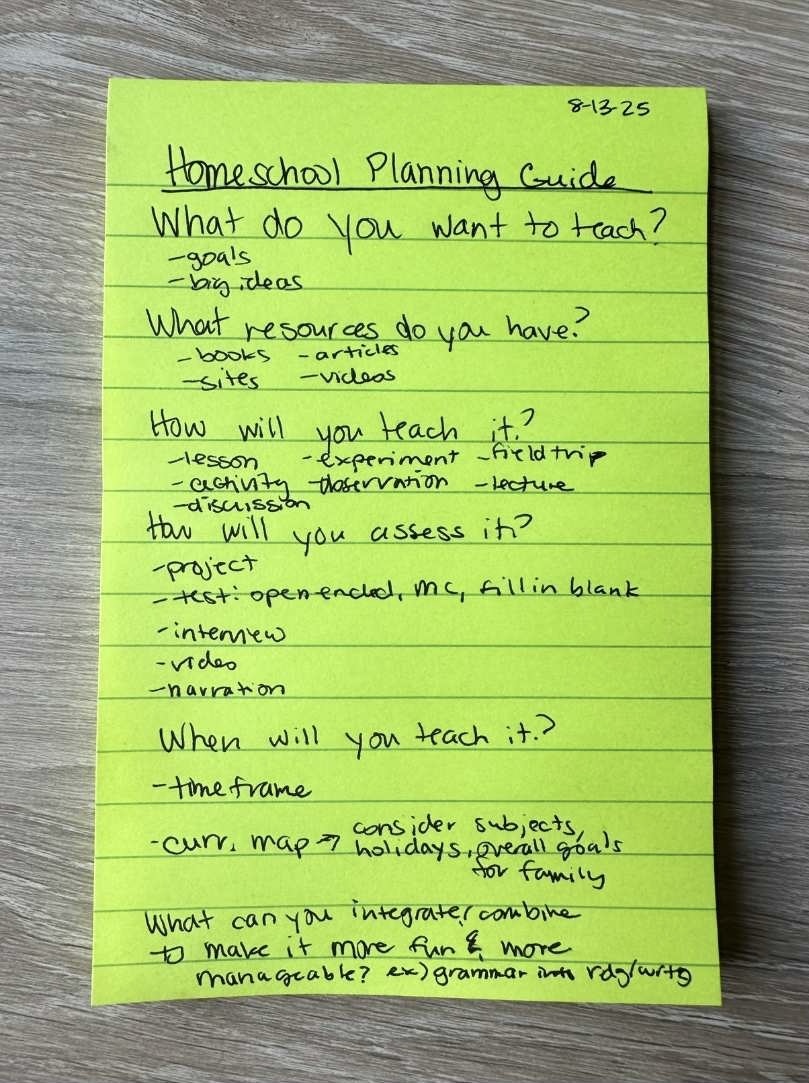
What do you want to teach?
Learning Goals
Consider each of your children and what they personally need to master the most this school year. For example, if you have a very young student, maybe teaching them to read is your top priority. If you have a student who has struggled in math, maybe your top goal is to get them back on grade level in that area. Customize your learning goals for each of your children, but know what your most important goals are for each child this year.
Big Ideas
What are some big ideas that you really want to delve into for this school year. Do you want to teach about history from a certain time period? Botany? Anatomy? Seasons? The writing process? Which big ideas will you focus on in each subject area this year.
Standards/Objectives
Now narrow it down even farther and come up with the specific learning outcomes per subject. You can get these from lessons in curriculum you’re following, from standards lists found online, or you can write your own.
Example:
Understand and explain the role of the federal reserve in the economy of the United States of America.
What resources do you have?
Books
Choose books carefully that align with a Biblical world view and teach the topic well. Choose a variety of books to teach from. Even if you choose a curriculum, supplement with other books on the main topics you’re teaching about. Vary the types of books you offer. You need biographies, fiction, non-fiction, poetry, a variety of levels- like picture books and chapter books, etc. Don’t shy away from more difficult books for younger readers, just read and explain them with your child. Don’t shy way from easier “everybody” books either, they are fun to read at any age.
Websites
Carefully select websites that may provide resources to help you as you plan and prepare your lessons.
Videos
Find videos that coincide with your lessons to help the content stick and provide your children with visuals. Videos can really help your children to understand abstract concepts as well as give other information that may not have already been covered on the topic you’re teaching. Always either preview the video or at least view it alongside your children to be sure that it is good for your teaching and appropriate.
- Books
- Websites
- Videos
- Articles (printed, copied)
How will you teach it?
- Observation (can you observe what you are teaching?) make it real and relevant
- Field Trip
- Lecture (Does you or someone you know/ someone online have knowledge about this topic to share? Lived experience is the best teacher, so if you don’t have the experience – find someone who does and is willing to teach.
- Discussion
- Lesson
- Activities
- Experiment
How will you assess it?
- Project
- Test: open ended (essay, ?s), multiple choice, fill in the blank, matching, etc.
- Interview
- Draw/label it
- Interview
- Video
- Narration
- Performance (Recital)
When will you teach it?
- Time frame
- Plan how long to spend on each big idea/theme
- Know typical routine/schedule
What can you integrate/combine to make it more fun and more manageable?
- Ex) Integrate grammar into reading by looking for parts of speech in a novel you’re reading and discussing why certain adjectives were used. Then, write your own sentence using adjectives to make the description more interesting.
Putting It All Together
You need to align these aspects. For example, maybe you want your child to learn how to do woodworking, but you have no skill in that area and you don’t know anyone who does. In that case, either make it your mission to find the resources to teach it, or choose something for now that you do have the resources to teach.
What not to do
- Don’t just buy and follow curriculum because you think that’s what everybody else does- instead choose what aligns with the Bible and is in a format that you and your kids enjoy and learn well from.
- Don’t stick with something that is miserable because you paid money for it. You’re not stuck. There are plenty of free ways to teach and you can do it without that book if it’s making learning not be fun.
Write down your plan
After considering the things listed above, for each child and each subject, write the basic plan down for what you’ll teach this school year. You can make your plan as simple or as detailed as you want. Just make sure you have the supplies you need to put the plan into action. Remember to be flexible if you realize something isn’t working as you hoped. It’s okay to change it up as needed. You can also record as you go, to keep track of what you actually accomplish each day. I like to do that in a planner, so my planner is more of a record.
You’ve got this!
Use this homeschool planning guide to help you plan your year. Remember to stay flexible, keep up the good work, and have fun!